United States
 Canada
 Mexico
 Colombia
 El Salvador
 South Africa
 Jamaica
 Philippines
 India
India Egypt
Egypt Greece

 Read
ReadIn 2025, U.S. consumer spent USD 257 billion during the holiday season, which was a 6.8% jump from the year before. This clears the story that revenue scales up, when customer contact volume scales harder. But, if your eCommerce customer support partner isn’t operationally ready, your holiday season becomes your most expensive customer churn event of the year.
More in this Blog
Brands that failed to meet customer service expectations experience a drop in repeat purchase as compared to brands with robust holiday support outsourcing. That’s why top eCommerce brands align with the right preparation timeline. And this playbook is for such brands.
It describes what happens over the year, how to prepare, and onboard the right eCommerce customer support partner.
What Peak Season Looks Like from Customer Service Perspective
Before you prepare for the holiday or peak season, you need to understand what hits your BPO team, because it’s not just volume. It is a specific mix of ticket types, compressed into days with zero tolerance for training gaps.
The ticket breakdown during peak season:
- WISMO (Where Is My Order?): The most dominant ticket type during peak is about inquiry about order status. It accounts for 30-40% of all support tickets in normal periods and climbs to 50% or higher during peak season. Each WISMO ticket costs USD 5 – 25 depending on channel. And at an average of 3,000 tickets per month during peak season, it can cost USD 15,000 to 60,000 to eCommerce customer service operations.
- Return and Refund Requests: As per historical data and YoY trends, return requests spike 25 – 45% immediately after Christmas, beginning December 26 and peaking in early January. This surge also causes resolution time to increase, which directly strains QA scores.
- Order Modification and Cancellation: This ticket category comes under high handle time, high escalation risk. Compressed delivery windows and buyer’s remorse are the primary factors driving it.
- Promo Code and Payment Failures: Volume spikes unexpectedly during flash sales and Cyber Five. If checkout fails and help isn’t provided instantly, the sale is lost, not just delayed. For such scenarios, your business needs PCI compliant customer service for eCommerce.
Understanding this ticket distribution is what separates brands that ramp their BPO partner strategically from those that throw headcount at the queue and hope for the best.
Turn More Shoppers Into Loyal Customers

The Holiday Support Outsourcing Preparation Calendar
Most articles, reports, and content will tell you to “start early”. But, only here you will learn what starting early means, broken into specific actions by quarter.
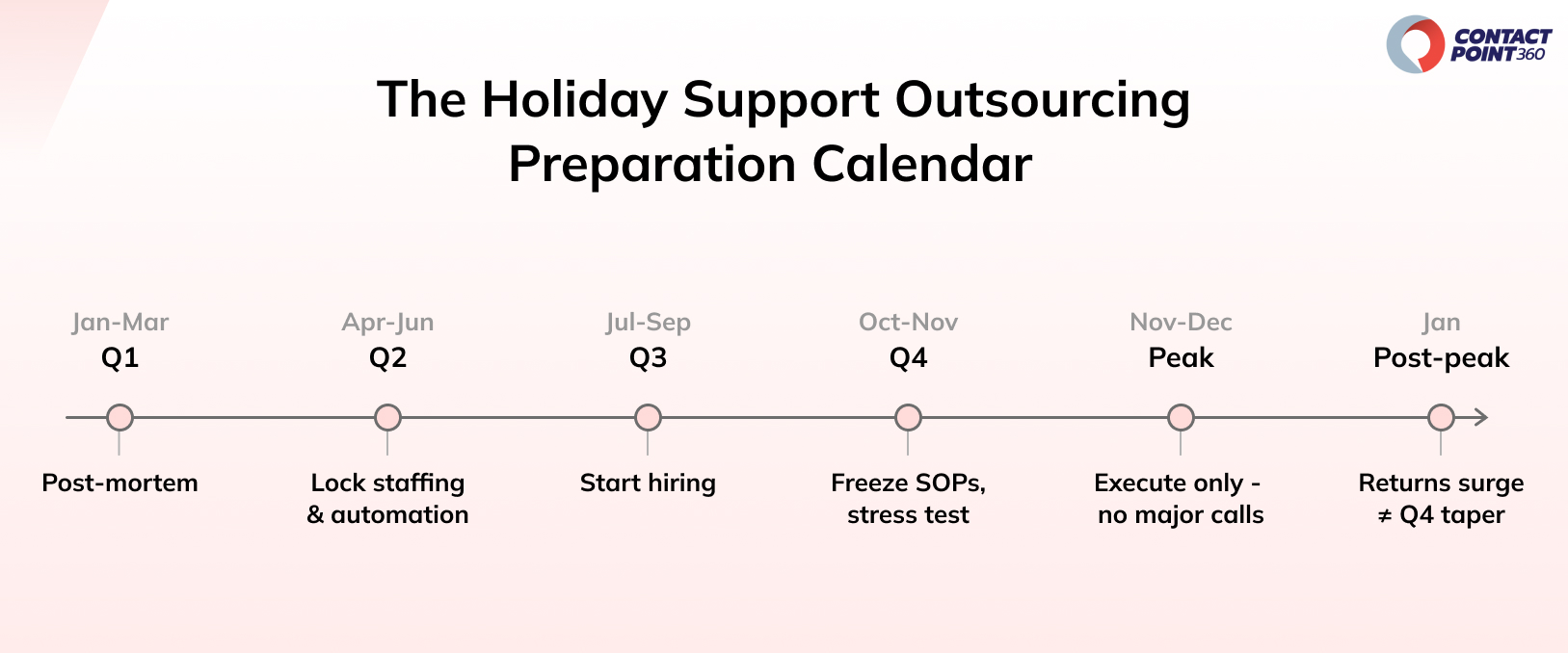
| Timeframe | What Your Outsourced Customer Service for eCommerce Should Be Doing |
|---|---|
| Q1 (January – March) | Run a post-mortem on the prior peak season to identify which ticket types drove recontacts, where escalations broke down, and what quality gaps emerged between core and seasonal agents. |
| Q2 (April – June) | Finalize your staffing architecture by defining what percentage of peak capacity will be permanent versus flexible. Establish AI and automation criteria, scope, and implementation priorities. |
| Q3 (July – September) | Begin hiring and onboarding outsourced eCommerce customer service agents. Recruiting in July and August provides a larger talent pool and allows sufficient time for shadow training and supervised live support before peak season. |
| Q4 (October – November) | Lock all SOPs and escalation paths. Test DTMF and IVR flows for payment-related tickets, activate real-time monitoring, and conduct tabletop stress tests to validate operational readiness. |
| Peak Season (November – December) | Execute, monitor, and optimize operations. Avoid major staffing, process, or technology changes during this period, as they can negatively impact performance during peak demand. |
| Post-Peak (January) | Manage the returns surge as a separate operational event rather than an extension of Q4. Document lessons learned immediately and retain top seasonal agents to help update knowledge bases and improve future peak-season readiness. |
Phase 1: Staffing – The Math Your eCommerce BPO Partner Should be Running
Seasonal hiring looks straightforward until your model the actual cost. A seasonal agent costs USD 7,000 – 11,000 per agent for 8-10 weeks including training. That is before quality variance is factored in. And quality variance between core and seasonal agents is the most consistent finding in post-peak BPO reviews.
The right model for peak seasonal staffing is not liners headcount. It’s a core-flex architecture, consisting of:
Core team (permanent): These agents carry institutional knowledge, such as product specifics, brand voice, escalation muscle memory. They handle complex tickets related to payment disputes, fraud-adjacent returns, and multi-shipment gift orders.
Flexible capacity (seasonal): These are temporary agents trained for high-volume, well-documented ticket types, such as WISMO, standard returns, and order status. Their workflows are SOP-driven and AI-supported.
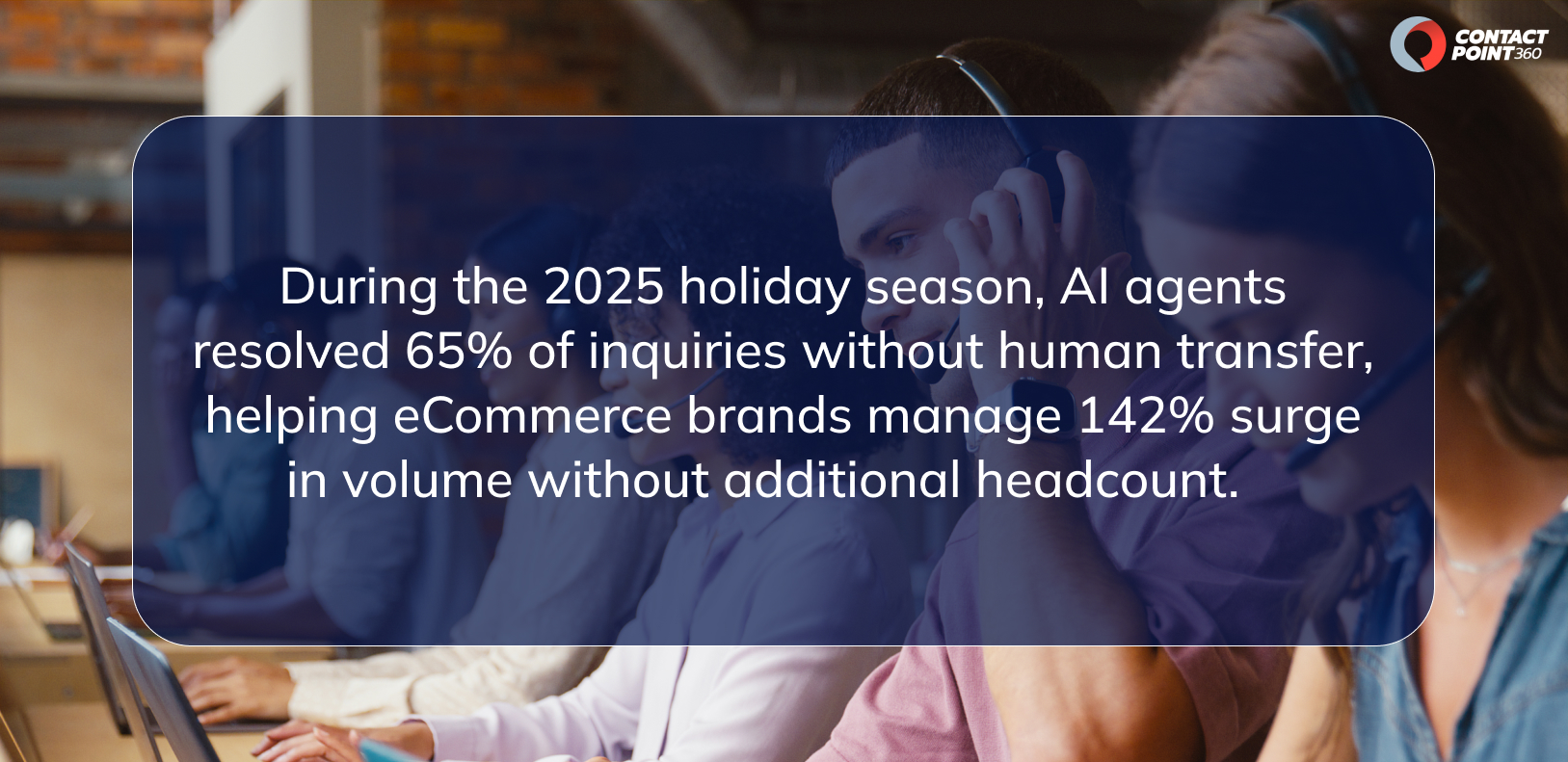
AI layer (always-on): Agentic AI is always behind the scenes to handle deflectable volume 24/7 without increasing the headcount cost.
Source: Customer Think
Scale Customer Experience Without Growing Overhead
Phase 2: AI and Automation – What to Deploy and What Not To
AI is not a switch you flip in October. It is a part of eCommerce customer support infrastructure you build and test in Q2 and Q3 so that by November it handles volume you don’t need agents for.
What AI handles well in eCommerce peak season:
- WISMO and order status lookups.
- Standard return initiation and eligibility checks.
- Promotional code validation and reissuance.
- FAQ deflection, such as shipping timelines, holiday cutoffs, and policy questions.
- After-hours answering services to prevent queue abandonment.
What AI should not handle alone:
- Escalate return disputes with fraud indicators. For this you should outsource eCommerce customer service.
- High-value order concerns – customer anxiety + product value = need a human.
- Multi-shipment gift orders with delivery address errors.
- Any interaction where a customer has already been failed once.
The evidence is clear on outcomes. Brands that combine AI and human support during peak season saw higher customer retention.
The question to ask your ecommerce customer service outsourcing provider is not “do you use AI?”. It is “What is your AI-resolved rate for WISMO tickets on our program specifically, and how was it trained on our order management system?”
Phase 3: The Second Surge – January Is a Separate eCommerce Peak Season
Most eCommerce brands stop at December 31. That is the mistake that produced January chaos.
Post-holiday returns are not a tail-off of Q4 volume. They are a distinct operational peak with a different ticket profile, different complexity, and a compressed timeline that can punish under-prepared teams.
Here’s what your BPO partner needs ready before January 1:
- A dedicated returns queue, separate from general support inquiries.
- Agents trained on your return policy edge cases instead of standard flow.
- Fraud escalation protocols with clear agent decision authority. (Refund vs. escalate vs. flag)
- Extended peak season staffing commitment through mid-January, not just December 31.
- A real-time returns dashboard shared with your operations team.
If your outsourced eCommerce customer support partner treats January as a “wind-down” month, that assumption will cost you both margins and customer loyalty.
The KPIs to Track During Peak – And the Thresholds That Should Trigger Action
Most BPO programs track metrics weekly during normal operational. During peak season, weekly is too slow.
| Metric | Normal Baseline | Peak Alert Threshold | What It Signals |
|---|---|---|---|
| First Response Time (FRT) | Per SLA | 20% above SLA | Queue saturation; flex activation needed |
| First Contact Resolution (FCR) | 70–75% | Below 65% | Training gaps in seasonal agents or AI scope too narrow |
| Average Handle Time (AHT) | Program baseline | 15% above baseline | Escalation paths unclear; macros insufficient |
| Queue Abandonment Rate | < 5% | > 15% | Immediate overflow plan activation |
| CSAT Score | Program baseline | 5+ point drop vs. prior week | Systemic quality issue, not volume-related |
| WISMO Tickets (% of Total) | 30–40% | > 55% | Proactive notification system failure upstream |
| Recontact Rate | < 10% | > 18% | Resolution quality breaking down under pressure |
These thresholds should be agreed with your outsourced eCommerce customer support partner before peak begins.
Build Your Dedicated eCommerce Support Team
What To Audit Your BPO Partner On Before Q4
Before you are in the middle of it, run this conversation with your eCommerce customer service outsourcing partner:
Staffing Plan:
- What is the confirmed headcount by week, broken into core and flex?
- What is the training completion date for seasonal agents?
AI readiness:
- Which ticket types are in AI scope?
- What is the projected deflection rate and on what data is that projection based?
SOP completeness:
- Does your team have documented handling paths for your top 20 tickets types, including holiday-specific edge cases?
Technology stack:
- Are real-time dashboard live?
- Are alert thresholds configured?
- Is the omnichannel customer service tested under load?
Returns protocol:
- Is January treated as sperate planning event with its own staffing and routing structure?
Escalation authority:
- Do agents have clear decision right on refunds, credits, and fraud flags or does everything escalate and create a second queue?
Post-peak retention plan:
- Which seasonal agents will be offered bridge contracts to retain institutional knowledge for next years?
Any partner that cannot answer these questions specific to timeline and owners attached is giving clear indicator to avoid them.
Peak Season is Won or Lost in the Months Before it Begins
The eCommerce brands that came out of Q4 2025 with a high CSAT, revenue, and purchase rates were not the ones that spent most. They were the ones that planned ahead of others, outsourced eCommerce customer support between Q2 – Q3, and treated January as a separate event.
The ticket categories and increase in volume is predictable. Now, it’s your time to surprise your customers with a seamless customer experience during the holiday season.
If your current outsourcing partner cannot tell what their peak season staffing architecture looks like, what’s in AI scope, and how they will treat January returns surge, you need serious discussion or switch to leading BPO partner.
The window to handle holiday season volume is still open. In October, it’s only implementation, not planning.
Grow Revenue Through Exceptional Customer Experiences